Customer journey mapping is essential for organizations of all sizes. Customer expectations vary across all business sizes, and an omnichannel strategy is the only way to address their pain points.
The customer journey map is one of the most powerful tools for understanding customer expectations and delivering on their needs.
It helps you understand your customer's experience, a crucial factor in building an effective one.
After you understand your customers' journey, you can better plan your product or service offerings to meet their expectations and deliver on their needs.
In this article, let's examine what a client journey map is, its various elements, and how to create one that turns data into a winning customer experience.
What are some of the best ways to stay ahead of customer expectations and deliver a more effective customer experience? What are the best techniques available to turn data into a winning customer experience?
One of the foremost ways to deliver the best for your customers is through a customer journey map.
What Is a Customer Journey Map?
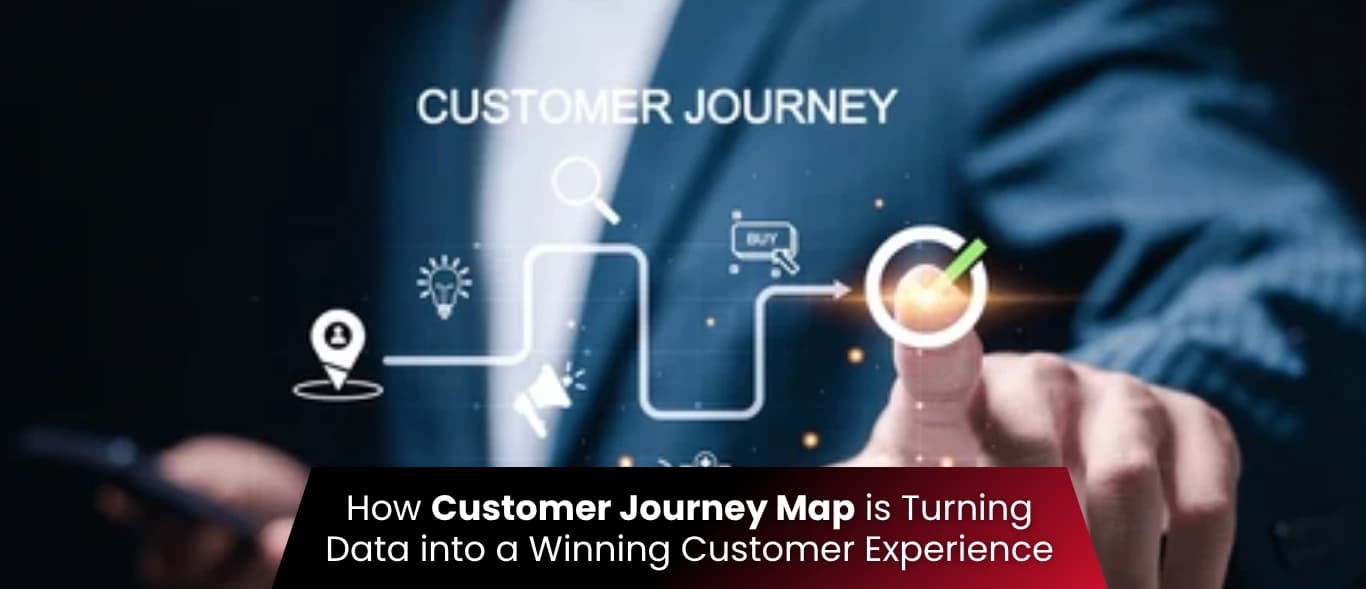
A customer journey map is a graphical representation of each interaction a customer has with a service, product, or brand.
The goal is to help you understand every contact point in the overall purchase lifecycle, design impressive experiences, and improve results.
In short, a customer journey map highlights every interaction, such as visiting your app or website, contacting customer support, or purchasing a product. It’s a technique to see how your customers see your brand.
The purpose of a customer journey map is to highlight your customers' experience from the moment they arrive on your website/app through the point at which they contact you.
The map is the visual representation of the journey that a customer follows while interacting with your product or service. It can be used to understand, improve, and refine your current processes.
It can help you understand how customers discover your product or service, why they find it useful, and ultimately why they return.
Creating a customer journey map is extremely useful for understanding what happens at every point in the customer's journey through your website and other channels.
Every interaction with the customer is an opportunity to make an informed decision about whether to act.
This touchpoint mapping will help you identify areas for improvement in your products and services, and move your business forward.
Customer journey mapping is a process that large corporations have used for years; however, thanks to rapid advances in technology, it has now also found its way into the hands of small businesses.
It provides a company with the opportunity to ensure it is not neglecting any critical customer interaction.
To get the most out of a customer journey map, allocate sufficient time and focus on it, rather than moving from task to task. This will help you fully understand your audience's needs and wants.
Related resource: The Power of Customer Analytics in Modern Marketing
Why Customer Journey Mapping Matters for Businesses
Many brands focus solely on revenue, but customers always consider their entire experience.
This is where the customer journey map makes a huge difference. A report from Salesforce states that today, 80% of customers consider a company’s experience alongside its products.
Thorough understanding of customers: You will get complete details on your customers' opinions about your service, not what they purchase.
Improved customer experience: By understanding customers’ pain points, you can address them and simplify their journey.
Identify journey gaps and optimize every touchpoint with advanced analytics
Powerful customer connections: When customers understand your services very well, they will start to trust your brand.
Intelligent decision-making: Rather than guessing, you can make decisions based on customers’ behavior.
Key Stages of a Customer Journey Map
This is a (minimum) four-stage process.
1. The customer is aware of your product or service, but not yet engaged. You can establish this stage by including several pages of questions that will require the customers to make decisions about your product or service.
At this stage, your customer is aware of your product or service and is researching it to determine whether they want to purchase it and what it will cost.
Example: What is this product, and what does it mean to you? What are the benefits of the product? Who is it for? What is it supposed to accomplish? What are the pros and cons? Why should I choose this product over other alternatives?
2. You now have an aware customer who knows about your product or service completely. In this 2nd stage, you want to encourage them to do additional research and comparison shopping.
Example: We offer same-day shipping and the best prices around.
3. The customer has purchased your product or service, i.e., the customer becomes engaged with your product or service. At this stage, your audience will begin using your product or service, allowing you to track their purchase history, comments, and social networking activity.
Example: To ensure the customer is comfortable with your product or service, we have included several FAQs and user guides.
Example: Do you know that the product can be used for multiple applications?
4. After the customer is engaged, they become loyal to the product or service. In this stage, your audience has developed a positive relationship with your product or service, making them more comfortable using it.
Types of Customer Journey Maps (With Examples)
There are at least three types of customer journey maps:
- Traditional Journey Maps
Traditional Journey Maps
A traditional customer journey map is straightforward and illustrates the general path a customer follows from their initial encounter with your product to the point of purchase.
A traditional customer journey map illustrates the sequence of events that occur during a customer's interaction with a company.
It also represents the typical path from your product's initial encounter to the point of purchase.
This is now considered a largely outdated method of mapping.
Customer Experience Maps
A visual representation of the customer's experience with a company.
Customer Experience Maps are becoming an increasingly important tool for companies to determine how their customers perceive them.
Static Journey Maps vs. Dynamic Journey Maps
| Aspect | Static Journey Maps | Dynamic Journey Maps |
|---|---|---|
| Updates | Updated irregularly and manually | Automatically updated consistently |
| Well-suited for | Early-stage CX initiatives or small companies | Digital-first businesses and data-backed enterprises |
| Use cases | Basic customer experience planning | Omnichannel personalization and real-time optimization |
| Customer behavior monitoring | Limited visibility into changing behaviors | Monitor behavior changes across several channels immediately |
| Accuracy | Can become outdated rapidly | More perfect due to consistent data updates |
| Decision-making | Reactive, and according to the past history | Proactive and predictive |
| Personalization | Generalized customer paths | Highly customized customer journeys |
| Business impact | Helpful for strategic planning | Helps increase engagement, retention, and conversions in real-time |
A Customer experience map is a type of customer journey map that illustrates the various steps a customer takes along their path.
It may define the steps a customer takes to complete a purchase.
This type of map does not indicate where a customer's journey begins. A customer experience map is an effective way of visualizing complex customer interactions in business.
Like all customer journey maps, a customer experience map is not just for new customers. It is also helpful for those with loyal customers. That is, this map does not show a traditional funnel.
Instead, it shows the different touchpoints and how customers interact with your product or service as they use it.
Because this map does not indicate where a customer begins their journey, it may display customers at different stages of their journey as they progress through your product or service.
These are customer journey maps that illustrate the steps along your customer's path to discovering a new product or service.
It may show the steps a customer takes in searching for a solution to their problem.
In this example, a customer starts by filling out a form on the company's website. He may then watch a video and continue his journey by reading written information.
He may then take a test and continue his journey. This customer journey map illustrates the different steps along a customer's path.
It does not indicate where a customer's journey begins. The end of the customer journey is when the customer decides to buy the product.
Create A Customer Experience Strategy
A customer journey map is part of your overall customer experience strategy.
Recognize that customer experience is the single most crucial factor in whether a customer will buy from you.
Therefore, you should ensure your service delivers an exciting, engaging customer experience so customers are willing to go out of their way to buy from you.
The question is 'are you listening?'
Here are some of the essential stages of your customer experience strategy:
Define the customer
- Pre-purchase: Collecting information from customers to understand their needs
Explore
- Identify the customer's problem, and when to act
Compare
- Compare your product or service with similar products and services
Purchase
- Make the customer feel as if they are going to get something valuable
Advise
- Teach the customer what to do next so they can resolve the problem independently.
Specifically, here are tips to boost your customer experience, the things that can improve the day-to-day experience of your customers and make their lives easier:
Make it easy to use your product. If there's a way you can make it easier for your customers to find your product, whether by making it easier to find on your website or by posting tutorials on YouTube, do it.
Ensure they can easily locate and utilize your products as intended. Develop a customer-centric culture within your organization.
You want your team to think of customers as more than just someone who uses your product or service.
You want your team to consider them as people first, and then customers of the product you're building.
If your team can get better at talking to customers, they can actually hear what they have to say, and in turn, it can help you improve your products.
Related resource: Visualizing Customer Journey Using A Sankey Diagram
How to Create A Customer Journey Map
- Identify the significant activities in your business
Your buyer persona should be a comprehensive representation of your customers' needs and wants.
To create a successful buyer persona, you need to understand what the customer wants and needs before you sell them anything.
This can be achieved through customer surveys, focus groups, interviews, and market research.
The approach you take to creating your buyer persona will depend on your product or service and what you are selling.
For example, if you are selling luxury cars, you need to design a buyer persona who can afford them.
It means targeting affluent potential buyers who prefer high-end brands.
It is important to note that when designing your buyer persona, you should avoid restricting yourself to a single customer type.
Additionally, ensure that you include a diverse range of customer types in your buyer persona.
This will enable you to target market segments with similar needs and interests.
The personality traits of buyers who will purchase your product or service should not be limited to gender, age, educational background, or occupation.
Customer experience journey maps should carry all the touchpoints. Customers want to communicate with companies through various channels.
Customers follow different routes on these maps as well, and those routes must be reflected on the maps.
When creating the map, begin by identifying your customers and the various touchpoints they have with your company.
For example, to design a customer journey map for sales professionals, they should include the following touchpoints:
- Account managers and representatives
It is also a good idea to include customer complaints, forums, blogs, and social media connections as touchpoints.
Once you have identified the touchpoints, use a mind map to organize your ideas. Then start sketching the map.
Although there are no established protocols, specific guidelines are in place. Draw a map showing how your customers interact with your company.
Keep in mind that the look and feel of your maps should be consistent throughout the map-making process.
That is why the colors, fonts, and imagery used on customer journey maps should not be a one-time decision.
It must be dynamic so it can be adapted to each company's needs.
Customer Journey Mapping Best Practices
Before designing an ideal customer journey map, you must consider the following points to create a valid document:
Customer journeys are not right every time
Often, your customer journey does not accurately reflect the experiences of all customers. Your valuable client may revisit the trip at any point during their process.
Not all customers have the same experience, even though they are listed in the same segment. It's not a problem.
This can be done to simplify visualizing the user journey.
Split departmental silos
Breaking down silos will provide a clear understanding of the customer's experience.
Keep the journey map actionable
A customer success journey map should be actionable and realistic.
Customer Journey Analytics vs Traditional Funnel Analytics
| Feature | Customer Journey Analytics | Traditional Funnel Analytics |
|---|---|---|
| Customer view | Offers a holistic and unified customer journey view | Provides a linear view of customer movement via a funnel |
| Channels covered | Omnichannel and multi-channel analysis | Limited to a single campaign |
| Predictive analytics | Supports customer intent analysis and predictive modeling | Primary focus is on historical conversion performance |
| Attribution analysis | Provides multi-touch attribution across platforms | Usually depends on simple attribution or last-click models |
| Customer retention insights | Help points out engagement gaps and churn risks | Focuses on acquisition and conversions |
| AI and ML support | Commonly integrates automation and AI-based analytics | Limited AI-based behavioral intelligence |
| Business impact | Improves customer loyalty, customer engagement, and lifetime value | Improves conversion rates within funnel stages |
Your primary focus should be on the customer's pain points, so you can take the necessary actions to address them and improve them.
Hence, conducting thorough user research is essential for a detailed analysis. You can go through the whole process to experience all the painful hump at the touchpoint.
Use the customer journey as a tactical tool
Keep the map in front and center. Soon after designing it, place it at the forefront of user experience decisions to provide a unified experience throughout the whole process.
To provide consistent customer support, it is essential to understand the customer's journey.
This is to avoid issues before your customers raise concerns.
You have to consider the following four areas for that:
When do your customers first interact with your brand? Discovering where your customers found you helps you predict their future needs and preferences.
You can use time-driven automation to provide valuable suggestions based on when they subscribed.
When do customers make purchases? Analyzing how long the customer takes to complete the evaluation phase can help your support team identify what they want and when they want it.
What products attract them? Identifying what products or services grabbed their attention can help you answer various questions.
If a customer browses a product page multiple times, send them an email with additional information to help them make a decision.
When do they leave? Inspecting why and when a journey ends is equally essential.
Customer retention is part of customer experience mapping because delivering the right message before customers cancel can help prevent such poor experiences.
Ask your customers what's stopping them from making purchases, and document those experiences on customer onboarding journey maps so you can gradually improve them.
Customer Journey Mapping Tools
These include:
Web analytics tools to help you understand the return on investment of marketing and advertising efforts.
Website analytics tools are also necessary not only for measuring your website, but also for tracking the path that leads to it.
You should be able to accurately state, for example, what percentage of website visitors convert.
You can also use website analytics tools to measure what visitors are doing on your site as they navigate it.
You should also track when people reach a specific page on your site. Is this percentage higher than the average?
You might decide it is worth adding a menu of similar products to one of your pages, or you might add a pop-up to encourage them to sign up for your email list.
Customer satisfaction surveys provide a snapshot of customer satisfaction, including what they like about your products and services, what they dislike, and what is missing.
Customer feedback forms collect customer sentiment and intent, serving as an early warning system for what customers like and dislike about your products and services.
In-app journey mapping tools enable you to map the sequence of events that occur when a customer clicks a button in your app, and compare it with the sequence that occurs when a user who has already decided to make a purchase searches for it.
Customer Journey Analytics: Turning Data Into Insights
Customer journey analytics is the process of analyzing where your customers are in their buying process and how you can influence them to move closer to purchasing your product.
In addition to increasing customer lifetime value (CLV), businesses utilize it to enhance customer loyalty and drive revenue growth.
Analyzing the customer journey provides teams with valuable insights into customer behavior, informing strategic decisions and enhancing overall customer experience.
This form of analytics begins with a customer journey map, but you must first determine which customer journey you want to track.
Sequential: The most common type of customer journey map, representing a linear process from one point to another, with intermediate stages in between.
It's the most appropriate choice for product and service design.
This helps understand customer behavior to drive revenue.
The right journey mapping strategy helps you listen, understand, and act faster.
It works by iterating through each stage of the customer's journey until you reach the last step before a sale.
This is useful for products and services that have multiple steps. Or for a service like management that involves interacting with various departments.
Circular: Similar to sequential, but it does not always have an end.
With a circular process, it's possible to return to the start of the customer's journey.
For example, online software companies often employ this method to understand the customer journey and determine customer acquisition strategies.
Branch: This represents the point at which you can engage with the customer as they progress through your brand, company, or product.
The first way to measure customer journey analytics is to use data to identify the current state of your customer's journey and compare it to the desired state.
By identifying your customers' pain points, you can eliminate them from the customer journey.
A critical component of identifying pain points is understanding the customer's journey through the current state and its various touchpoints.
A second way to measure customer journey analytics is to compare your company's desired state (or vision) with the actual customer experience along that journey.
It will make it easier to evaluate and prioritize opportunities to improve your customer experience.
The power of customer journey data is now more accessible than ever, thanks to integrated insights that enable more accurate journey analysis.
This form of analytics increases your ability to analyze customer journeys and score journey performance.
Related resource: Data Visualization Using Sankey Diagram
How Data Analytics Improves Customer Journey Mapping
Connects customer contact points across channels
Customers don’t always follow a straight route to purchase.
They might:
- Identify a product via Instagram
Data analytics lets companies unify these touchpoints into a single customer journey.
Identify customer challenges
Analytics-driven journey mapping can identify:
- Pages causing high drop-offs
Enables organizations to understand customer intent
Many visitors are researching products, but others are ready to make a purchase instantly.
Data analytics let organizations identify:
- Product references
For example:
- First-time visitors may get educational content
Enables real-time journey analysis
Companies depend on data analytics to:
Supports predictive analytics
Modern analytics platforms can predict future actions.
Predictive analytics allows businesses to:
Helps measure journey performance
Data analytics offers measurable insights, including:
- Time-to-conversion
Predictive Customer Journey Analytics
As customer expectations change, brands need more analysis than reports and dashboards.
They require systems that can foresee customer needs. Predictive customer journey analytics lets brands:
- increase conversions
AI and ML models inspect this data to find trends, behavioral signals, and correlations.
They can effectively process large volumes of both structured and unstructured customer data.
Omnichannel Customer Journey Mapping
Modern customers think only in terms of "online" and "offline" channels, expecting a consistent experience across every interaction.
They just expect companies to notice them whenever they are active.
Without a comprehensive view across channels, brands usually face challenges, including:
- Irregular messaging
AI-Powered Customer Journey Mapping in 2026
AI has changed how companies understand their customers' needs and how they translate those insights into superior journeys.
Using ML, AI can interpret and process huge volumes of data in seconds and predict behaviors.
Listed below are several ways AI has changed journey mapping:
Live orchestration
AI responds quickly to behavior, be it an abandoned cart, a chat inquiry, or a fresh category view, and triggers the upcoming step automatically.
Predictive personalization
AI predicts customers' needs and next actions and delivers personalized messaging across every interaction before customers make a request.
Enhanced efficiency
AI automates visualization and analysis, allowing teams to focus on strategy and creativity.
Customer loyalty and happiness
Every small contact point makes a difference.
AI monitors sentiment and engagement patterns to identify friction points and improve the experience before customers leave.
Major Components of AI Journey Mapping
The base of the AI journey mapping system involves three major features:
Data integration: connects data from every customer interaction, such as website interactions, calls, emails, and social media, to create a comprehensive view.
Predictive modeling: Examines customers’ past history and current behaviors to predict their needs and deliver appropriate support or products.
Automated responses: Triggers customized emails, workflow, or chat follow-ups according to customer behavior patterns.
Continuous learning: keeps on improving periodically by learning from new data and human feedback, filtering recommendations, and journey maps.
Customer Journey Mapping for Retail & eCommerce
Customer journey mapping in eCommerce works by combining fragmented data from POS, loyalty, supply chain systems, and digital stores to visualize and measure where operational friction occurs.
Let’s see a few tips for eCommerce customer journey optimization:
- Conduct A/B tests to improve underachieving touchpoints
A retail customer journey map contains the following major components:
Customer personas:- show various groups of your customers
Journey stages:- cover awareness, thorough research, consideration, buying, and post-purchase support
Customer opinions, feelings, and challenges: inspecting customer emotions at every stage to identify areas for improvement.
Benefits of Customer Journey Maps
Here are some of the benefits of customer journey mapping:
Improves product road maps
This is vital for companies unsure of their direction but needing to plan a successful course of action.
By examining the customer journey from start to finish, companies can determine which product roadmap best suits their needs and what the journey entails.
Demonstrates value
The journey map helps to demonstrate value.
It shows where the customer is heading at each stage of the buying process and what they will receive upon reaching the end.
Helps to build trust
Building trust through the customer journey helps to increase loyalty.
Customer journey maps can help businesses determine whether they are effectively meeting customers' needs throughout the customer journey.
Increases customer engagement
Customer engagement is crucial for a company to maintain and enhance customer relationships.
Putting the journey on a map helps engage customers at each stage.
It also helps show how much effort the customer will need to put in to complete the journey successfully.
Even better, customer journey maps can engage customers by showing where their attention goes.
Increases sales
Customer journey maps can be used to present the product, thereby increasing sales.
Customer journey maps can help businesses reach more customers by showing customers' progress.
Overall, such journey maps help increase awareness and engagement across the business.
It increases market reach, as journey maps help reach more customers by displaying the product on a single page.
Challenges of Customer Journey Mapping
Let's discuss a few crucial challenges and how to tackle them:
Insufficient data
One of the significant challenges in CJM is collecting and examining sufficient data to create perfect maps.
Data can come from various sources, including analytics, feedback, interviews, CRM systems, and social media.
Customer preferences and behaviors change periodically. Moreover, not all data is relevant, accurate, or easily accessible.
A few pieces of data may be outdated, inconsistent, or missing.
To tackle this challenge, marketing professionals need clear goals, diverse data sources, and data validation.
Complexity and diversity
Managing complexity and diversity is another challenge. Clients may have numerous personas, behaviors, emotions, and segments.
They may utilize various devices, platforms, and channels to stay connected with the brand.
Furthermore, client journeys are not static or linear but are evolving and dynamic.
To tackle this challenge, marketing professionals need to focus on common and significant client journeys, use scenarios or personas to represent various client situations and types, and regularly update and filter their maps based on feedback.
Actionability and effect
Converting the insights and discoveries from the journey maps into actionable steps and tangible results.
However, only a few marketers face challenges in identifying and prioritizing significant and feasible actions, as well as in evaluating the impact of their campaigns on client loyalty and satisfaction.
To tackle this challenge, they must define realistic objectives and metrics for their CJM project and use maps to monitor and report on outcomes.
Not able to understand customers clearly
Creating the right customer journey map needs a deeper understanding of your consumers.
Many organizations struggle with partial data, unclear customer segmentation, or outdated personas.
Evaluating emotional impact
While eCommerce or retail platforms are experts at gathering quantitative data, they normally fall short in capturing the emotional elements of customer journeys, including happiness at receiving a product or frustration at checkout.
Disorganized organizational silos
In large retail organizations, various teams cover different sections of the customer journey, such as customer service, sales, and marketing. This siloed concept results in fragmented customer experiences.
Limited resources
Retail companies of small and medium size usually lack the tools, expertise, and budget to create and maintain complete customer journey maps.
5 Mistakes to Avoid When Conducting a Customer Journey Analysis
The customer digital journey map is a tool you must use effectively to achieve better results.
For a customer journey mapping project to succeed, it's not enough to follow best practices.
It's also important to consider the mistakes that can lead to a project's failure. Let's highlight some in detail:
Not having clear goals
Immature journey mappers are excited to design a CJM without clear goals, aiming to discover all the defects in their journeys using a unique journey map.
No research or weak research
Sometimes, customer journey mapping consultants build a map based on assumptions or without proper research.
They contact only a few customers to study their journey, don't speak with clients facing challenges, etc.
At this phase of CJM, unreliable data will not yield good results.
Collecting client feedback, conducting interviews, running polls or surveys, and gathering client reviews can make sense.
Wrong perspective
Building a journey map from a client's point of view and selling your product to others are bad ideas.
Put yourself in your clients' position; building a CJM around their thoughts, goals, platforms, and expectations can be the best way to provide better service.
Badly developed personas
Demographics need to be considered when creating personas.
A customer persona describes a specific group of people, enabling you to view other groups with related features.
Here, you must focus on behavioral traits, what they think of your brand, what scares or attracts them, and so on, as these can reveal a lot about your client's mindset.
Early stop or late start
Some journey mappers decide to build a map from beginning to end, neglecting all the phases that occur before a client browses a website and completes a purchase.
Think of all the stages in time when a client browses a product or service. Don't forget to begin from the client's angle.
For you, a user's journey begins when they browse a website or take an action, but their actual journey starts when they see your ads online.
The same applies to customers who don't contact you directly but still give their feedback, whether offline or online, or engage with your product.
Single map for all personas
You try to design a unique journey for all your clients. If you don't have the resources to create separate maps for all personas, select only the most important ones and make them for those personas.
You can collect all personas into a single map, transforming it into a multi-person CJM.
How Express Analytics Tracks Consumer Journey Maps?
Express Analytics helps you:
Improve customer journey contact points
Enhance the complete experience and optimize customer-journey touchpoints using insights from journey maps.
Express Analytics lets you pinpoint challenges and regions for improvement, enabling you to modify your campaigns for outstanding results.
Measure influence
Measure the influence of touchpoints on customer conversion and satisfaction rates.
Express Analytics tools to measure the performance of your strategies and make data-based decisions to yield better results.
Visualize customer journeys
Create thorough maps that explain how customers communicate with your organization across several stages.
This visualization helps you identify crucial touchpoints and understand the full customer experience.
Conclusion
Customer journey maps are a powerful tool to create a better customer experience. The focus of such a map is on the customer's needs, not your product or service.
The map itself is an interactive tool that helps customers understand their experience through each step of their buying journey.
The map should not be regarded as a goal or even an objective in itself, but rather as a vehicle to help customers achieve their goals.
Frequently Asked Questions
What is customer journey mapping?
A customer journey map is a visual representation of customers' experiences with a brand over time across several channels. Mapping the customer journey highlights how customers feel and the struggles they face at each stage.
What are customer journey touchpoints?
Customer journey touchpoints are different moments when a customer comes into contact with your business, directly or indirectly. Each touchpoint decides how a person sees the brand, and the integrated impression determines whether they purchase again, recommend, or churn.
How do companies use journey analytics?
Customer journey analytics links and inspects every customer behavior across offline and digital channels to optimize experiences.
It is the perfect platform for understanding your customers' end-to-end engagement with your brand across voice, web, sales, service, mobile, and marketing.
What tools help create customer journey maps?
Tools such as Medallia, Qualtrics XM Discover, Adobe Journey Optimizer, Figma, Miro, and UXPressia help brands generate and analyze customer journey maps by illustrating customer behaviors across touchpoints.
How to Create a Customer Journey Map in 7 Steps?
Creating a powerful customer journey map includes 7 major steps:
1. Define clear goals for the map
2. Collect and examine customer data
3. Determine customer personas
4. Map out all touchpoints across the journey
5. Identify customer emotions and expectations at every stage
6. Pinpoint challenges and improvement areas
7. Update and review the map periodically