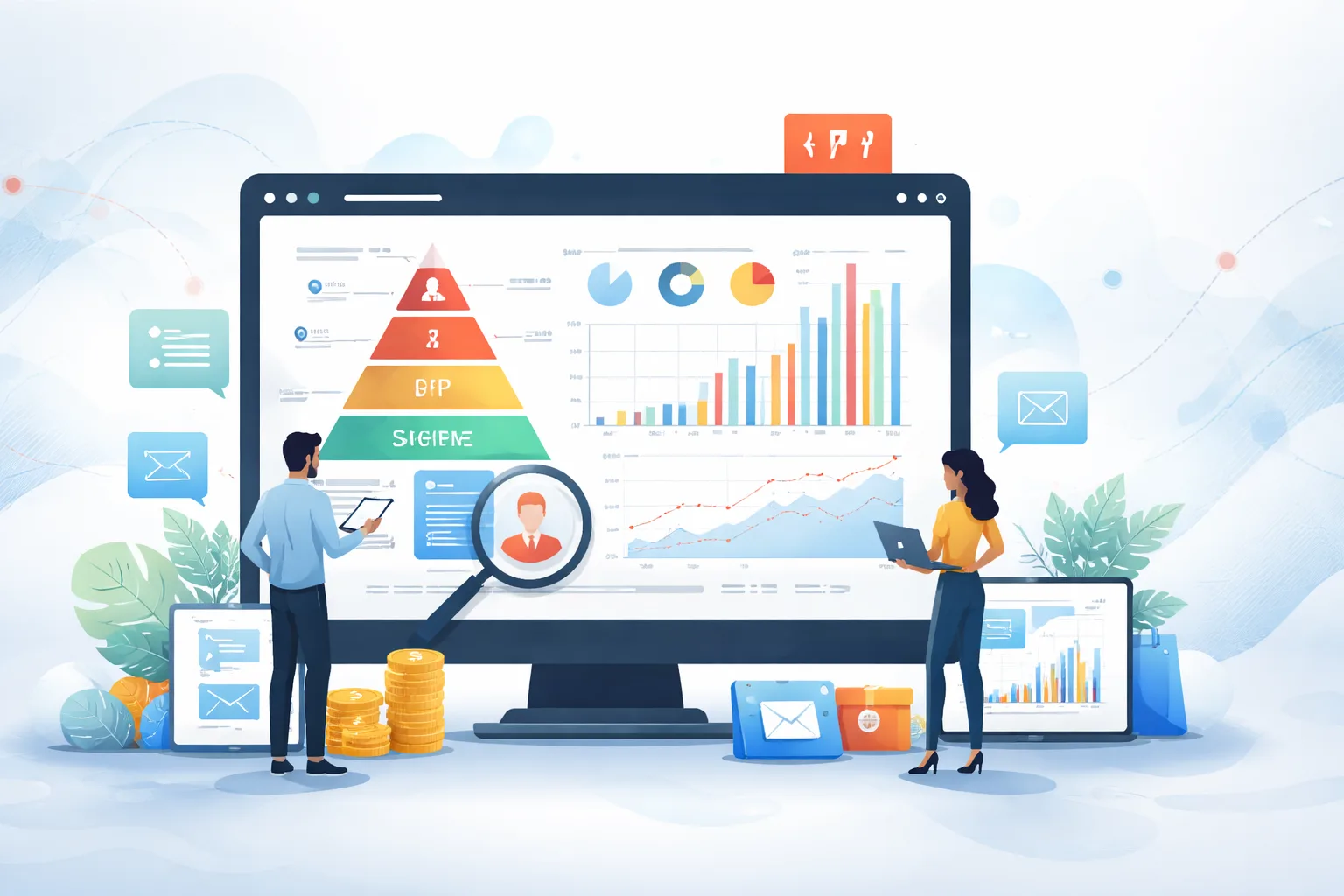
The RFM (Recency, Frequency, Monetary) analysis is a powerful tool for understanding customer behavior and segmenting customers based on their purchasing patterns. It is based on three key metrics:
- Recency: How recently a customer made a purchase
This analysis helps businesses identify their most valuable customers, tailor marketing strategies, and optimize customer relationship management.
Approach
Our approach to RFM analysis involved the following steps:
- Exploratory Data Analysis (EDA)
Fig 1. A heatmap showing the distribution of customers across different RFM score combinations.
Customer Segmentation using various clustering algorithms
- Model Evaluation and Comparison
Fig 2. Radar Chart of Customer Profiles to compare the characteristics of each customer segment
Sources
The analysis was performed on the Online Retail dataset, a transactional dataset containing all transactions occurring between 01/12/2010 and 09/12/2011 for a UK-based, registered non-store online retail.
The company mainly sells unique all-occasion gifts. Many of the company's customers are wholesalers. The dataset includes information such as:
- InvoiceNo
Algorithms Used
K-Means Clustering
Purpose: K-Means is used to partition customers into distinct groups based on their RFM scores, to minimize within-cluster variance.
Method: The optimal number of clusters was determined using the Elbow Method, resulting in 4 clusters.
The algorithm iteratively assigns customers to the nearest cluster centre and adjusts these centres to minimize the variance within each cluster.
Fig 3. Elbow Method - the approach used to identify the optimal number of Customer Clusters
Result: The K-Means clustering produced well-defined groups, with a Silhouette Score of 0.6114, indicating a good separation between clusters.
Hierarchical Clustering
Purpose: Hierarchical Clustering builds a hierarchy of clusters, allowing a flexible choice of the number of clusters by cutting the dendrogram at different levels.
Method Applied: Ward's linkage method was employed to minimize the variance within clusters.
A dendrogram was created to visually assess the appropriate number of clusters, leading to a 4-cluster solution.
Result Obtained: The resulting clusters were similar to those from K-Means, with a Silhouette Score of 0.5893.
This method provided a clear visual representation of the customer hierarchy.
Fig 4. Dendrogram for Hierarchical Clustering, showing the hierarchical relationships among customers.
DBSCAN Clustering
Purpose: DBSCAN (Density-Based Spatial Clustering of Applications with Noise) identifies clusters of varying shapes and sizes while also recognizing outliers as noise, which is particularly useful for identifying anomalous customer behaviors.
Method Applied: DBSCAN was applied with an epsilon of 0.5 and a minimum sample size of 5.
The algorithm clusters customers based on density: points in dense regions form clusters, while sparse regions are treated as noise.
Result Obtained: DBSCAN achieved a Silhouette Score of 0.6561, effectively identifying core clusters and outliers.
It proved helpful in distinguishing customers with unusual purchasing patterns.
Fig 5. DBSCAN Clusters depicting the identified clusters and noise points
Gaussian Mixture Model
Purpose: GMM models the data as a mixture of multiple Gaussian distributions, offering a probabilistic approach to cluster assignment that allows for soft clustering.
Method Applied: The algorithm was run with four components, corresponding to the number of clusters.
GMM estimates the Probability that each customer belongs to a probability cluster, providing a flexible clustering solution.
Result Obtained: The GMM yielded a Silhouette Score of 0.1213, lower than the other methods, indicating some overlap between clusters.
However, it offered valuable insights into the probabilistic nature of customer behavior.
Fig 6. GMM Clusters depicting the overlap between clusters based on Probability
Decision Tree Classifier
Probability Trees are used in RFM analysis to create interpretable rules for customer segmentation.
By analyzing RFM data, Decision Trees identify key thresholds for Recency, Frequency, and Monetary values to classify customers into different segments.
Method: A Decision Tree classifier was trained on the RFM data, with the customer clusters (from K-Means) as the target variable.
The tree was pruned to avoid overfitting, ensuring that the resulting rules were both accurate and generalizable.
Result:
- The Decision Tree produced a set of clear, interpretable rules to classify new customers by their RFM scores.
Fig 7. The confusion matrix compares actual and predicted values. The balanced performance across all segments means that the model can be confidently used for customer segmentation based on RFM Scores.
Schedule a free consultation with our customer analytics experts to discover how we can help you build sophisticated customer segmentation models that drive marketing success and customer growth.
Model-Wise Conclusion
K-Means Clustering
Performance: K-Means provided well-separated clusters with a high silhouette score, making it a reliable method for segmenting customers.
Cluster Insights:
Cluster 1 (High Value): Customers with high frequency and monetary value but low recency, ideal for loyalty programs.
Cluster 2 (Low Value): Customers with low frequency and monetary value, or re-engagement strategies.
Hierarchical Clustering
Performance: Hierarchical clustering also provides well-defined clusters, similar to K-Means, and is helpful when a dendrogram is needed for better cluster understanding.
DBSCAN Clustering
Performance: DBSCAN effectively identified noise and outliers, resulting in a high silhouette score.
However, it may not be ideal for datasets with continuous customer engagement.
Gaussian Mixture Model
Performance: GMM provided more flexible clustering but had the lowest silhouette score, indicating less distinct clusters.
Result Summary
- RFM Scoring successfully categorized customers based on their Recency, Frequency, and Monetary values.
Recommendations
Focus on High-Value Customers
Action: Prioritize marketing efforts and personalized services for customers in clusters with high Frequency and Monetary values.
Rationale: Customers who frequently purchase and have a high monetary value represent the most profitable segment of the customer base.
By focusing marketing efforts on these high-value customers, you can increase their loyalty, maximize their lifetime value, and encourage repeat purchases.
Re-Engagement Campaigns
Action: Design targeted campaigns for customers with high Recency scores to bring them back to active status.
Rationale: High Recency scores indicate that a customer has not made a purchase recently.
By targeting these customers with re-engagement campaigns, such as special offers or personalized messages, you can encourage them to return and make new purchases, thereby reducing churn and increasing retention.
Cross-Selling and Upselling
Action: Use customer profiles from different clusters to identify opportunities for cross-selling and upselling.
Rationale: By understanding the purchasing behavior and preferences of each customer segment, you can tailor your cross-selling and upselling strategies.
This not only increases the average order value but also enhances customer satisfaction by offering relevant products that meet their needs.
Loyalty Programs
Action: Develop or refine loyalty programs based on the characteristics of the most valuable customer segments.
Rationale: Loyalty programs can significantly increase customer retention and lifetime value, particularly for high-frequency and high-monetary customers.
By offering rewards and incentives that appeal to these segments, you can foster long-term loyalty and encourage ongoing engagement.
Personalized Marketing
Action: Use the Decision Tree rules to create customer segments that are easy to interpret for tailored marketing strategies.
Rationale: Decision Trees provide clear rules for segmenting customers based on their RFM scores.
These rules can be used to design personalized marketing strategies that resonate more with each segment, leading to higher conversion rates and better customer experiences.
Churn Prevention
Action: Monitor customers moving towards higher Recency scores and implement retention strategies.
Customers with higher Recency scores are at higher risk of churning.
By identifying these customers early and implementing retention strategies, such as targeted offers, personalized outreach, or loyalty incentives; you can reduce the likelihood of losing them and maintain their engagement with your brand.
Regular Analysis
Action: Conduct RFM analysis periodically to track changes in customer behavior and adjust strategies accordingly.
Rationale: Customer behaviors and market conditions change over time.
Regular RFM analysis keeps you updated on these changes, ensuring your marketing strategies remain effective and aligned with current customer needs and preferences.
Integrate with Other Data
Action: Combine RFM analysis results with other customer data (e.g., demographics, product preferences) for more comprehensive insights.
Rationale: RFM analysis provides valuable insights, but combining it with additional data can offer a more holistic view of your customers.
This integration enables more accurate segmentation and personalization, ultimately leading to better-targeted marketing and improved customer satisfaction.
Test and Iterate
Action: Continuously test different marketing approaches for each customer segment and refine strategies based on results.
Rationale: Not all marketing strategies will work equally well for every segment.
By testing different approaches and analyzing the results, you can identify the most effective strategies for each segment and refine your tactics to maximize their impact.
Customer Journey Mapping
Action: Use RFM insights to improve the overall customer journey and experience across different touchpoints.
Rationale: Understanding where each customer segment is in their journey allows you to optimize their experience at every touchpoint.
By applying RFM insights to customer journey mapping, you can enhance engagement, satisfaction, and loyalty by ensuring that customers receive the right message at the right time.
Understanding RFM Analysis
RFM analysis is a customer segmentation technique that uses three key metrics to evaluate customer value and predict future behavior:
The Three RFM Components
Recency (R)
- Measures the time since the last transaction
Frequency (F)
- Measures the number of transactions over time
Monetary (M)
- Measures the total or average transaction value
Let's break this down with a simple example:
Example:
Imagine you own an online clothing store. You have three customers:
Customer A: Bought something last week, buys clothes every month, and usually spends $100 per order.
Customer B: Bought something six months ago, buys once a year, and spends $200 per order.
Customer C: Bought something three months ago, buys every few months, and spends $50 per order.
How the RFM Model Works?
Recency: Customer A is the most recent buyer, followed by Customer C. Customer B bought a while ago, so they're considered less "recent."
Frequency: Customer A buys the most often, making them the most frequent shopper. Customer C is in the middle, and Customer B buys the least frequently.
Monetary: Customer B spends the most per purchase, but since they don't buy often, Customer A is considered more valuable overall.
How is the RFM Model Useful?
The RFM model helps you identify which customers are most valuable and which ones might need more attention. In our example:
- Customer A is a loyal, high-value customer—they buy often, spend regularly, and have bought recently. You might reward them with special offers to encourage them to come back.
Why Use the RFM Model?
Using the RFM model helps you focus your marketing efforts on the customers who frequently respond. Instead of sending random promotions to everyone, you can:
- Offer loyalty rewards to frequent buyers.
This personalized approach saves time and money while helping you retain your best customers and improve sales.
The RFM Scoring System
Traditional RFM Scoring
5-Point Scale (1-5)
- 5: Top 20% of customers
Example Scoring
- Recency: 5 = purchased within last 30 days, 1 = purchased over 1 year ago
RFM Score Combinations
High-Value Segments (555, 554, 545, etc.)
- Recent, frequent, high-spending customers
Medium-Value Segments (333, 334, 343, etc.)
- Moderate activity and spending
Low-Value Segments (111, 112, 121, etc.)
- Inactive, infrequent, low-spending customers
Implementing RFM Analysis
Data Requirements
Transaction Data
- Customer ID or unique identifier
Data Quality Considerations
- Complete and accurate transaction records
Calculation Methods
Recency Calculation
# Example: Days since last purchase
recency = (current_date - last_purchase_date).days
Frequency Calculation
# Example: Number of purchases in the last 12 months
frequency = count(transactions_in_last_12_months)
Monetary Calculation
# Example: Total amount spent in the last 12 months
monetary = sum(transaction_amounts_in_last_12_months)
Segmentation Strategies
Quintile-Based Segmentation
- Divide customers into five equal groups for each metric
Custom Threshold Segmentation
- Define specific thresholds based on business knowledge
Dynamic Segmentation
- Adjust thresholds based on business performance
Advanced RFM Analysis Techniques
Weighted RFM Scoring
Custom Weights
- Assign different importance to R, F, and M
Time-Decay Weighting
- Give more weight to recent transactions
RFM with Additional Dimensions
Product Category Analysis
- RFM by product category or department
Channel Analysis
- RFM by purchase channel (online, in-store, mobile)
Seasonal RFM Analysis
- Adjust for seasonal purchasing patterns
Business Applications of RFM Analysis
Marketing Strategy Development
Customer Retention
- Identify at-risk customers (low recency, high frequency/monetary)
Customer Acquisition
- Target lookalike audiences based on high-value segments
Customer Development
- Upselling opportunities for high-frequency, low-monetary customers
Campaign Optimization
Email Marketing
- Segment email lists by RFM scores
Direct Mail
- Target high-value segments with premium offers
Digital Advertising Frequency
- to lookalike audiences from top RFM segments
Customer Service and Support
Priority Customer Identification
- Flag high-value customers for premium service
Churn Prevention
- Early warning systems for at-risk customers
RFM Analysis in Different Industries
E-commerce and Retail
Online Retail
- Website behavior analysis
Brick-and-Mortar Retail
- Store visit frequency
Subscription Services
SaaS and Software
- Usage frequency and patterns
Media and Entertainment
- Content consumption patterns
Financial Services
Banking
- Transaction frequency and patterns
Insurance
- Policy renewal patterns
Measuring RFM Analysis Success
Key Performance Indicators
Customer Lifetime Value (CLV)
- Track CLV by RFM segment
Retention Rates
- Monitor retention by RFM segment
Revenue Growth
- Revenue growth by customer segment
A/B Testing and Validation
Campaign Performance
- Compare campaign results by RFM segment
Model Validation
- Regular RFM score validation
Challenges and Limitations
Data Quality Issues
Incomplete Data
- Missing transaction records
Data Accuracy
- Duplicate transactions
Business Context
Seasonal Variations
- Holiday and promotional effects
Customer Lifecycle
- New vs. established customers
Implementation Challenges
Technology Integration
- Data extraction and processing
Organizational Adoption
- Training and education
Best Practices for RFM Analysis
Data Management
Regular Data Updates
- Daily or weekly RFM score updates
Data Governance
- Clear data definitions and standards
Analysis and Reporting
Regular Review Cycles
- Monthly or quarterly RFM analysis
Actionable Insights
- Clear recommendations and next steps
Technology and Tools
Automated Scoring
- Real-time RFM score calculation
Visualization and Reporting
- Interactive dashboards and reports
Future Trends in RFM Analysis
AI and Machine Learning Integration
Predictive RFM Models
- Machine learning for RFM prediction
Advanced Analytics
- Deep learning for pattern recognition
Real-Time and Streaming Analytics
Real-Time Scoring
- Instant RFM score updates
Streaming Data Processing
- Continuous data ingestion and processing
Integration with Emerging Technologies
IoT and Connected Devices
- Device usage patterns and behavior
Blockchain and Decentralized Data
- Secure customer data sharing
Conclusion
RFM analysis remains one of the most powerful and practical tools for customer segmentation and behavior analysis. By understanding the recency, frequency, and monetary value of customer transactions, businesses can develop targeted strategies that maximize customer value and drive growth.
The frequency of successful RFM analysis lies in combining solid data management practices with strategic business insights. As technology continues to evolve, the integration of AI, machine learning, and real-time analytics will make RFM analysis even more powerful and actionable.
Businesses that master RFM analysis will be better positioned to understand their customers, optimize their marketing efforts, and build stronger, more profitable customer relationships. The future of customer analytics is bright, with RFM analysis continuing to play a central role in customer segmentation and marketing strategy.